Proscia has been named Global 2026 Best in KLAS for Digital Pathology in Europe and earned the top performance score in the U.S. in the 2026 KLAS Digital Pathology Report. Here’s why life sciences organizations should take notice.
Every clinical trial with a tissue-based endpoint, and every AI-based diagnostic you aim to bring to market, depends on clinical laboratories that are not only digitized, but running stable, open technology that pathologists are confident enough to use every day. The platform decisions those laboratories are making right now will determine what your programs can achieve for years to come.
Life sciences organizations rarely have direct visibility into how well a digital pathology platform actually performs in clinical production. KLAS has provided that intel to clinical audiences — conducting independent interviews with healthcare professionals in live environments based on a methodology that has been trusted for 30 years. When KLAS finds that a platform earns the highest customer confidence in the market that is a signal worth paying attention to. For life sciences organizations, it should shape how you think about the consistency and scale at which your programs can operate.
In 2026, Proscia became the first digital pathology vendor to earn top KLAS rankings across multiple regions in the same year: Global 2026 Best in KLAS for Digital Pathology in Europe and the highest overall performance score (95.2) in the first comprehensive US Digital Pathology report, with ‘A+’ or ‘A’ grades across all six customer experience pillars.
Here are three reasons these results matter.
1. The Network You Need to Scale AI Biomarkers and Companion Diagnostics
AI-based CDx deployment hinges on pathology AI infrastructure being in place at the labs and health systems where patients are diagnosed. Bringing an AI-based companion diagnostic to market is as much a distribution challenge as a scientific one. CDx developers have long recognized that commercial viability depends on whether the underlying digital pathology platform has sufficient clinical adoption to serve as a distribution channel.
More than 12,000 pathologists and scientists use Concentriq and KLAS independently verified that scale through direct customer interviews — surfacing 300,000+ estimated annual case reviews at a single organization.
KLAS also only evaluates vendors with sufficient live, production customers to generate truly representative results — and by that standard, Proscia is the most frequently considered platform vendor among US laboratories, hospitals, and health systems. 100% of customers indicate they would buy again and see Concentriq as part of their long-term plans.
This is a network with staying power. And that durability is precisely what life sciences programs require — a broad, high-confidence install base that reduces the fragmentation risk that has historically slowed CDx and AI biomarker deployment.
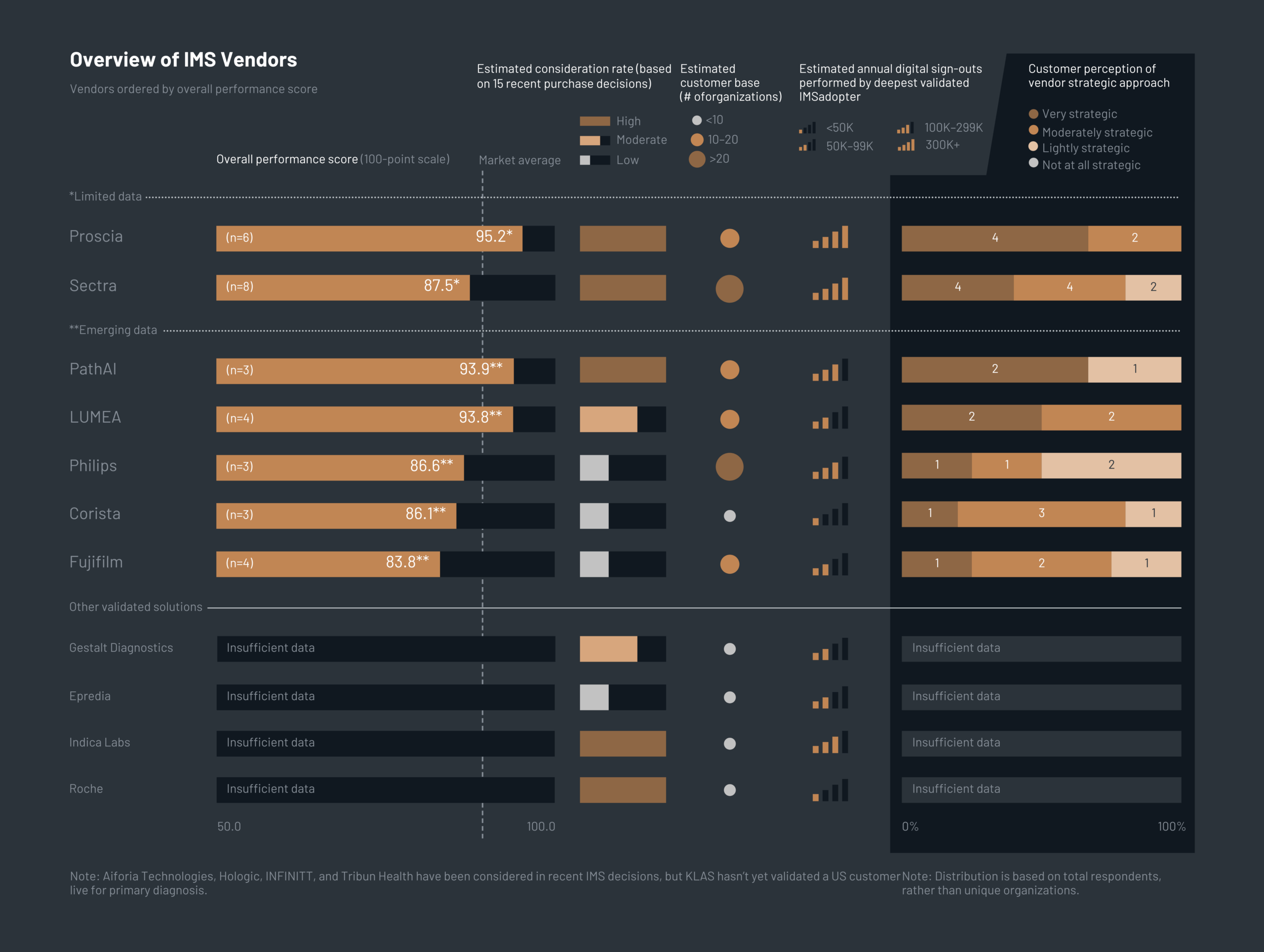
A Closer Look at KLAS’ US Ratings: KLAS independently evaluates digital pathology vendors across culture, loyalty, operations, product, relationship, and value — Proscia earned the highest validated performance score among US laboratories, hospitals, and health systems. Source: KLAS Research, Digital Pathology 2026
2. A Clinical Trial Platform Built for Speed, Quality, and Regulatory Success
For pharmaceutical companies and CROs managing multi-site trials with complex biomarker endpoints, the choice of digital pathology platform directly impacts timelines, data quality, and the regulatory defensibility of a submission. Manual processes, disconnected systems, and data integrity gaps are risks that compound across every site and every study.
Concentriq AP-Dx* was purpose-built for this environment: an interoperable, AI-native platform designed to support the full spectrum of clinical trial pathology workflows, from slide management and central review to AI-assisted patient stratification and biomarker scoring. Proprietary algorithms and validated third-party AI can be deployed directly into trial workflows, on an open architecture that doesn’t lock sponsors into a single AI vendor.
The KLAS results reinforce this — customers cited seamless integration as a top priority. Proscia’s 15+ unique LIS integrations mean pathologists across trial sites can adopt quickly, collaborate seamlessly, and run AI-assisted review without the friction of disconnected systems. For sponsors managing global trials, a platform validated by real-world clinical users, not just in a controlled R&D setting, provides confidence that trial sites can adopt and operate the technology without disruption.
AP-Dx is FDA 510(k)-cleared for primary diagnosis in the US and is also authorized in EU, UK, and Canada. For sponsors managing global trials, that footprint reflects Proscia’s ability to navigate and comply with complex regulatory frameworks across major markets. Structured from day one with the data integrity, audit trails, and validated workflows that regulators expect — and underpinned by SOC 2 Type II compliance and a proven cloud architecture that meets the security and operational standards GxP-governed programs require.
3. Continuity for Programs That Span Years
Biomarker development programs, companion diagnostic approvals, and clinical trial workflows are not short-term projects. They span years — sometimes decades. Over that time horizon, the digital pathology platform at partner laboratories needs to remain stable, supported, and advancing.
This is where the KLAS data is particularly telling. The signals KLAS captured go beyond product satisfaction — they measure the kind of long-term confidence that directly affects program continuity.

When a laboratory selects a platform with that level of long-term intent, it signals durability that directly benefits life sciences partners. The digital workflows, AI integrations, and data pipelines supporting a biomarker program or companion diagnostic are less likely to be disrupted by platform migration, vendor acquisition, or loss of technical support. Proscia’s continued investment in the product and partnership translates to capabilities that improve over time — and a foundation that life sciences programs can build on with confidence.
Proscia is Your Precision Medicine Partner
Proscia’s products are purpose-built while remaining architecturally connected across the portfolio. Concentriq LS for discovery and early-stage development, Concentriq AP*and AP-Dx for late-stage clinical trials and diagnostics, and Aperture connecting life sciences organizations to that diagnostic network.
That architecture reflects a larger ambition. Proscia’s mission to rewire pathology for precision medicine. None of what that promises, smarter diagnostics, therapies matched to the right patients, is possible if the everyday experience of digital pathology is fragmented and unreliable for the laboratories doing the work. The clinical adoption precision medicine depends on starts with a platform that laboratories actually trust. What KLAS confirmed, across two regions and based entirely on customer feedback, is that Concentriq has earned that trust. For life sciences organizations, that’s the foundation precision medicine requires: a clinical network that’s not just broad, but reliable and a partner built for the growing demands of modern therapeutic programs.
Connect with Our Team
To learn how Proscia’s KLAS results translate to your programs, connect with our team or access the full KLAS Digital Pathology 2026 US Report.
*Concentriq AP-Dx is FDA-cleared for primary diagnosis in the United States (U.S.) with the Hamamatsu NanoZoomer® S360MD Slide scanner and is licensed in Canada and CE‑marked under the EU IVDR for primary diagnosis. Concentriq AP-Dx is not intended for use with frozen sections, cytology, or non-FFPE hematopathology specimens. Concentriq AP and Concentriq LS are for Research Use Only. Not for use in diagnostic procedures. Proscia’s AI applications are available for research use only.
SOURCE: Proscia