Pictor Labs launches NVIDIA-powered on-prem AI staining at USCAP 2026, boasting 99-100% stain equivalence

 Pictor Labs, the UCLA spinout behind a suite of AI-powered virtual staining tools, used USCAP 2026, the annual pathology meeting in Los Angeles, to debut a dedicated on-premises hardware system that runs its full product line, including ClearStain, ReStain and DeepStain, entirely within a lab’s own walls.
Pictor Labs has offered cloud-based virtual staining since it commercially launched in late 2020, having been founded out of UCLA in 2019, and most digital pathology AI vendors have leaned into that model
But Pictor Labs is now making the case that cloud-only deployment is a barrier for a significant segment of its target market, especially academic medical centers and hospital pathology departments operating under institutional data governance policies that restrict or prohibit sending patient tissue images to external servers.
“We’re giving pathology labs the ability to run powerful, performance-evaluated AI models locally, securely, and at reliable high speeds while maintaining full control over data,” said Megan Rothney, PhD, VP of Product at Pictor Labs, in a statement.
The tissue preservation challenge
In conventional pathology, every chemical stain physically consumes tissue. For a small biopsy core requiring H&E plus special stains and IHC panels, serial sectioning can exhaust the specimen before molecular testing can even begin. Virtual staining generates stain-equivalent images from a single unstained brightfield image using deep learning, preserving the tissue block for downstream analysis.
Pictor’s product suite covers virtual H&E generation from unstained tissue (ClearStain), virtual re-staining of existing H&E images (ReStain), and generation of multiple virtual stain types — H&E, IHC, and special stains — from label-free tissue for research applications (DeepStain). The company reports that pathologists found ClearStain images visually comparable to chemically stained slides in 99–100% of regions reviewed.
What the NVIDIA box actually does
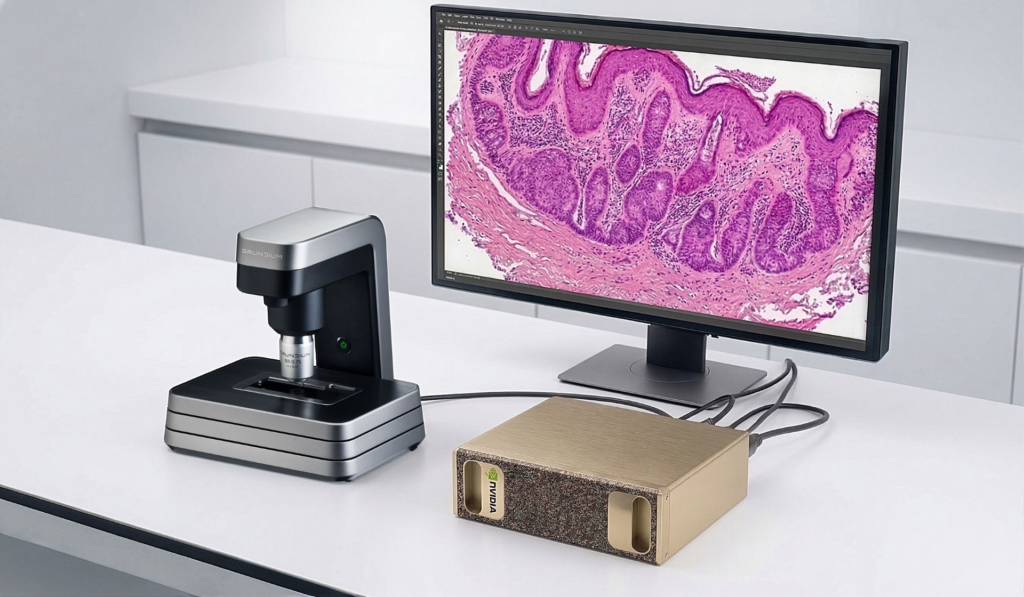
The On-Prem system is an inference-only appliance. It runs Pictor Labs’ pre-trained virtual staining models locally, with no model training or fine-tuning on site. It connects directly to existing slide scanners and image management systems; the company demonstrated Grundium scanner compatibility at USCAP, though the broader integration story with Leica, Hamamatsu, and Philips instruments that dominate installed bases remains to be detailed.
The underlying compute is an NVIDIA DGX Spark, a desktop AI workstation built on the GB10 Grace Blackwell superchip. The Spark delivers one petaFLOP of FP4 AI performance in a form factor smaller than a shoebox (150 × 150 × 50.5 mm) with 128 GB of unified memory. At a current retail price of $4,699 (up from $3,999 at launch due to memory supply constraints), it’s a strikingly accessible platform for production AI inference.
In the following Q&A, Pictor Labs executives unpack the regulatory and technical hurdles of bringing virtual staining directly to the lab bench.
Is Pictor Labs actively pursuing FDA clearance (510(k) or De Novo) for diagnostic use? If so, which stain types (H&E, special stains, IHC) is the regulatory submission targeting first?

Megan Rothney, PhD VP of Product
Megan Rothney, PhD, VP of Product PictorLabs: Pictor Labs is actively evaluating regulatory pathways across multiple jurisdictions, including potential engagement with agencies for its virtual staining solutions. Our products are currently offered for research use only (RUO), and we are continuing to build the data and validation needed to support future regulatory considerations.
At this stage, we are focused on generating the appropriate evidence and aligning with regulatory expectations as part of our broader strategy. As the field of AI-enabled pathology continues to evolve, we are taking a measured approach to determining the most appropriate pathways forward.
Can Pictor Labs point to any third-party validation, published performance data, or institutional deployments that support the “production-ready” designation under the RUO context?
James Kelley, MD, PhD, Chief Medical Officer PictorLabs: Pictor uses the same virtual staining engine across both cloud and on-prem deployments, meaning the underlying model, weights, and inference pipeline are identical. As a result, the visual quality and information content of the generated virtual stains are consistent between environments.
In practice, outputs from cloud and on-prem systems are expected to be equivalent for research use. Minor numerical differences may occur due to standard variations in hardware, GPU architecture, or floating-point computation across environments, but these do not result in meaningful differences in image appearance or interpretation in a research context.

James Kelley, MD, PhD, Chief Medical Officer
Because the staining engine itself is unchanged, any differences between deployment options are operational rather than analytical, such as inference speed, data transfer time, and infrastructure configuration, rather than differences in virtual stain output.
Hardware specs: Can you share any specifications on the On-Prem hardware unit itself?
Megan Rothney, PhD, VP of Product PictorLabs: The on prem solution we are demonstrating this week at USCAP runs on the NVIDIA DGX Spark unit. This small form factor, single GPU unit is great for busy lab environments where space is at a premium and computational needs are high. Pictor doesn’t require any custom hardware configurations, making this a stable “off the shelf” package.
SOURCE: R&D World