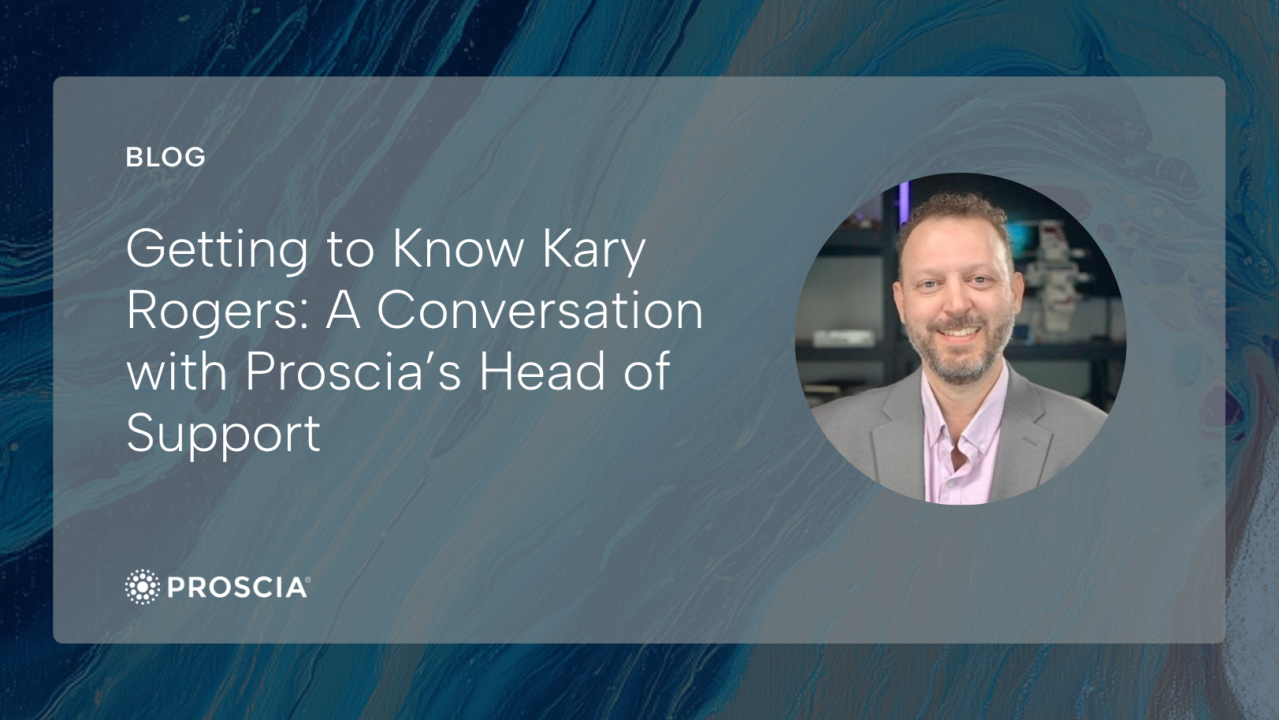
Proscia: Getting to Know Kary Rogers: A Conversation with Proscia’s Head of Support

 From Proscia on LinkedIn
When evaluating an enterprise pathology platform, many life sciences organizations and diagnostic laboratories focus on the features it offers. This makes sense since scientists and pathologists will rely on that functionality every day.
At Proscia, we believe that product functionality is one important part of the experience that we deliver to our customers. Support is also a key priority because it helps our users to make the most of their investments, and mission-critical software demands nothing less. That’s why we’re excited to introduce Kary Rogers as our new Head of Support.
Kary has worked in technical support for over 15 years, with a career path taking him from senior support engineer to executive leadership across enterprise networking and security companies. Kary has set strategy and led execution for organizations scaling in hyper-growth phases, owning enablement, escalation governance, AI transformation, and services excellence, while partnering with product, engineering, and sales teams to drive positive outcomes for customers. Kary is based in San Francisco, California and has one daughter who is entering high school this year.
Our team recently sat down with Kary to discuss his background, support philosophy, and initial priorities. Read the Q&A for his full takes, and get the highlights in the video snippets.
Lets start with you. What is your background, and how did you end up leading support in digital pathology?
A: I’ve spent my career building and leading enterprise support teams at multi-billion dollar networking and security companies. This is a path that I naturally gravitated towards. I love solving problems, my background is technical, and I thrive when the stakes are high.
Early on, I got dopamine hits from solving hard technical problems for customers. As a leader, I’ve enjoyed clearing the path so my team could find the fix and then identifying the bigger strategic solutions that prevent a problem for many customers at once.
My professional journey has deeply embedded mission-critical support in my DNA. Networking and security products sit inline in a company’s core infrastructure, meaning that a failure isn’t cosmetic. Depending on the size of the company, thousands of people couldn’t work until that failure is addressed. My teams would be operating under real compliance obligations while fixing it.
What drew me to Proscia is that our platform is mission-critical in a human-centered way. In networking and security, the stakes are measured in productivity and risk. Here, we’re helping redefine the way that disease is diagnosed and treated, with a real impact on patients and their loved ones. Our mission to rewire pathology for precision medicine is what gets me out of bed in the morning.
This is my first job in the pathology space, and learning the domain has been the most interesting part so far. I’ve spent my time getting to know our customers, their goals, and how they use Concentriq. This has included visiting a diagnostic lab. I’ve never been asked “do you want to see a placenta” at work before. I said yes.
I’m technical enough to recognize that a slow image load is rarely one thing, and that the answer usually lives in the seams between systems. What has struck me most in this role is just how many moving parts there are in the work of scientists and pathologists. If any one part of the systems they use breaks down, their day can come to a halt. This could mean delaying the next life-saving drug program or forcing someone to wait longer for a diagnosis they are already worried about. Understanding these moving parts changes how you support customers, and this is a perspective you can’t get from a dashboard.
The opportunity I see in front of me, and the one I’m most excited about, is to make support a reason customers choose Proscia. I want them to adopt our software with confidence that we recognize their needs, are committed to them, and are not just where they turn when something breaks.
What do you care about most in how your team supports customers?
A: Ownership of the outcome. When you come to us with a problem, we own it until it’s resolved.
This includes problems that extend beyond Concentriq. Your environment has a lot of moving parts: our platform, an interface into your scanner and LIS, integrated AI applications, your network and storage. Your team shouldn’t have to work out which vendor’s boundary a failure falls on, and you shouldn’t have to project-manage three companies to get one answer. This is why we have joint support agreements in place with our Proscia Ready partners. We stay in it with you and work with other parties behind the scenes to get you the resolution you need.
You should expect this level of support because of what’s at stake, whether that’s a pathologist sitting in front of an empty worklist because this morning’s scans haven’t landed, or a research team with a data cutoff on Friday with an AI application that stops returning results. Urgency and the right solution are both non-negotiable, and we can’t trade one for the other.
You should also expect the same support experience no matter who picks up your ticket. 100% of our customers told KLAS Research that they would buy again. I believe that operational discipline is important in keeping customers happy, and we must continue delivering a Best in KLAS experience.
The standard that I hold the team to is simple: no one out-works us on your problem, and no one cares more about it than we do.
One of your biggest priorities right now is keeping customers on the latest release. Why?
A:Proscia releases product updates on a quarterly cadence. Each of these releases carries enhancements that came out of feedback from users like you: workflow improvements, new capabilities, changes we made because someone told us something was harder than it should be.
If you’re on a previous release, you simply aren’t able to benefit from these updates. Performance work and security hardening only travel forward, too. The best support you can ever get is the support you never need, and staying current is how you get it. This is a clear trend I’ve observed in my career.
This mentality is reflected in our product lifecycle and end-of-life policy, which backs the current release and the one before it. I’d rather you read that as a promise than a restriction. A version we can still patch and secure is a version I can make real commitments about. If your deployment has drifted behind, there are promises I can’t make to you and value you’ll be missing. You should hear that from me now rather than during an incident.
It’s also why we make upgrading to the latest version so easy. As our customers can tell you, we do the upgrade with you regardless of your deployment model. If Proscia hosts your environment, we handle it end to end. You’ll get advance notice of the window, and you can move the date as needed. If the environment is yours, we still take care of the upgrade: we review the environment first, plan the path together, agree on a window that works for your team, and stay on it until the operation is successful. And if you’re in a regulated or validated environment, tell us early and we’ll plan the upgrade around your validation cycle.
We’ll also reach out to you to make sure that you’re staying up-to-date.
How can I reach Proscia Support?
A: The Support Portal at support.proscia.com is the fastest path. Open a request there, or email us at support@proscia.com. Both land in the same place.
When you write, tell us the impact of your issue along with the symptom: who is affected, what you are seeing, when it started, and whether cases or studies are waiting on it. This information allows us to jump straight to fixing your problem rather than spending time confirming it first.
And if you want to schedule an upgrade, you can reach out via the same channels.
SOURCE: LinkedIn